Showing posts with label drugs. Show all posts

Thursday, August 6, 2015

Addict or sociopath?

Some people ask if they or an addict who they know is a sociopath. My understanding is that addicts often display the characteristics of sociopaths without being able to actually be diagnosed as sociopaths because it's not a permanent condition (e.g., recover from the addiction, recover from the sociopathic traits). I don't have any real experience abusing drugs, so it's hard for me to know when someone is just an addict or is also a sociopath?

From a reader:

Convinced that I may be a sociopath, or at least have some type of antisocial personality disorder, I've come to you for further analysis. I've come to the point where I can recognize patterns in my behavior, past and still occurring, that can be identified with sociopathic traits & characteristics. I’ve noticed my inability to empathize with my mother, or any of my relatives, and my lack of interest in others ideals or their emotions. In later infancy and early adolescence, I was described to be abusive and manipulative of my mother/sister during my father's absence while incarcerated. I would physically abuse my sister and take advantage of my mother’s tenderness and inability to deny me of almost any privilege. My father's arrival into my life brought structure and discipline within the household. I was very hateful of my father, initially, but respected his ability to deliver swift punishment with complete rationality. We had a lot in common which lead to me favoring him over my mother. But I still persisted in my mischief. In elementary school, I made friends easily and could band them together to accompany me in my nefarious schemes. It came to the point where my father couldn't afford to leave work anymore to beat me himself, so he gave consent to certain instructors and faculty members to do the job for him in his stead.

I grew fond of my father but still felt emotional unattached to him. For example, when he was hospitalized in the result of a stabbing during a street fight, I wasn’t very emotionally receptive and didn’t feel any sense of urgency for his well-being. During the hospital visit, I feigned sadness in order to seem concerned. My attempt to fool him wasn’t successful. When he saw me he immediately knew that my tears lacked sincerity and smiled at me while lying on his bed, with his abdomen stapled together.

 I think that because of him and his almost militant approach at disciplining me, I turned out to be much more tame than what I could've been. As I grew older, I used lies and manipulation in order to avoid being beaten. Although it wasn't foolproof and it ended up contributing to my family members deeming me generally untrustworthy, I was able to maneuver around and stave off immediate punishment.

In high school, I was extremely conflicted. My father wasn't around anymore, due to his past criminal charges coming back to haunt him. I was then elected to be the man of the house and was expected to fill his shoes. I tried to emulate him and his role as a diligent, selfless, and stern family man. That proved to be very difficult. In some ways, it was easy to fashion myself after him. He could be extremely calculative. In addition, my apathy could be mistaken for benevolent qualities similar to his selflessness and generosity. Ultimately, I felt inadequate in my role. My responsibilities also hindered me from indulging in the typical activities that a normal teenager would have been able to. 

I also felt a slight betrayal from my mother, who couldn't accept my general impartial attitude towards my duties and at the fact that she was very intrusive of my privacy. Whatever discoveries she made as a product of her habitual prying, she became more and more aware of my true nature. I simply did what I felt like doing, as long as I felt it didn't have a detrimental affect on others. I believed that it was justified. She had hopes for me to grow into a loving and compassionate son who was considerate of other’s feelings, and primarily of hers’. I thought of her as a mess, at times. She could be very emotional and it didn't have a pull on me. She would question my love for her but I would say things like I loved in my own way. I feel that I do love her as my mother but am not very fond of her as a person. I grew to be very close to my sister. I hold her very dear to me, despite our past violent relationship.

Upon graduating from high school, I was accepted to one of the best design schools in America. I chose to major in illustrations because I was very good at it. After completing my freshman year, on the slow track of a part time student, I felt quite passionless about drawing in general. Around that time, I became unemployed and was earnestly looking for work. I took to craigslist and went for a rather unordinary job for someone of my background and stature. Growing up middle class, others felt that it was odd that I felt compelled to sell $2,000 vacuum as a cold call, door-to-door salesman, in trailer parks to boot. I didn’t know exactly why at the time, but I didn’t have any qualms with the work and had a rather positive outlook. During that time period, I believe that I was at my most sociopathic. I played the role of a seasoned salesman well, as I went from trailer to trailer pitching a sale to people who were obviously financially unfit to buy a vacuum for the price of a used car. People were often forced to buy with the alternative option to finance the payments on the vacuum. The money was terrible, due to the company being an actual pyramid scheme, but for some odd reason that did not concern me. My mother recommended that I should find work elsewhere, after a month. 


 Working in the environment that I did, I fell into recreational drug use. I began to experiment with MDMA and LSD to rouse myself or try to gain some direction, because I fell into apathy. It ended up being quite detrimental. I started to feel emotions and couldn't understand them. I started to feel extremely alienated and off kilter. I felt weak and had numerous episodes of uncontrollable sobbing. Sometimes from depressions, anxiety or deep joy. I did not like it. Going to raves and partying every weekend was also taking a toll on my school life and finances. I stopped for a short period of time and turned to drinking. I felt much more I control while intoxicated from alcohol. I also started to experiment with narcotics (Xanax, Adderall, Oxy, Cocaine). They induced almost the same feeling. Oxy and Xanax put me into a state of dismissive drowsiness that I am not very fond of. Cocaine and Adderall were almost identical in how they induced energetic highs with a trace of overzealous aggression, when tapped into. All of these drugs gave me the ability to draw off of a spectrum of emotions that I normally couldn't. I appreciated it, but wasn’t fully convinced that they were going to be beneficial to my quest of self-discovery. They eventually led to me being kicked out from under my mother's roof and my current homelessness. Nevertheless, I am complacent. Without a working vehicle, I am unable to work as my position of delivery driver. I am currently stationed near a well-populated and budding town where I have access to nearly free food and Wi-Fi. I spend my days reading books in a local cafe that I steal from Barnes and Nobles. On weekends, I spend my time in the company of my female familiars that I've met during my drug and alcohol filled adventures with friends. My family does not know of my homelessness only because I feel that it will complicate things if they did.

Monday, May 5, 2014

Truth serum?

I had dinner with some doctor friends of mine who were relating stories about how people react under anesthesia. My favorite story was about a 14 year old kid started hallucinating and feeling like he was being kidnapped by his doctors. When the doctors told him, "No, we like you, we're your friends."

The kid screamed back, "You like me?! You want to rape me?!"

After like 10 minutes of trying to calm him down, they decided to give up on the procedure for the day. The patient had stopped screaming enough for the doctors to explain that they were about to get his parents, and that seem to relax him. While the doctor was in the waiting room explaining to the parents about the child's adverse reaction to the drugs he heard a nurse yelling, "He's running!"

The child had apparently faked compliance to trick his captors into thinking he would cooperate with them. Really, he was just biding his time to escape. Unfortunately, as he sprinted away from the clinic, he seemed to be headed directly for a busy street and was still in his impaired condition. The doctor kicked off his clogs and started running after him in his socks. When the kid saw the doctor behind him, he freaked out again, running even faster. Finally the doctor caught up with him and tackled him to the ground before he ran out into the busy intersection.

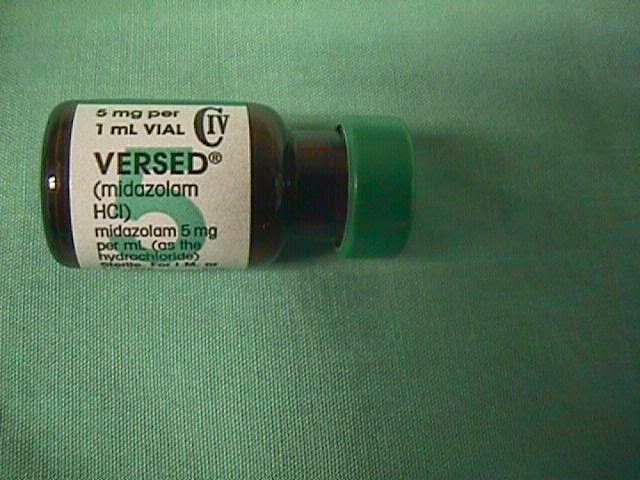
But the stories that I thought were most interesting from a philosophical point of view were the stories about patient reactions to the drug Versed/Midazolam. Apparently it is a psychoactive drug with some funny side-effects. From Wikipedia:

In susceptible individuals, midazolam has been known to cause a paradoxical reaction, a well-documented complication with benzodiazapines. When this occurs, the individual may experience anxiety, involuntary movements, aggressive or violent behavior, uncontrollable crying or verbalization, and other similar effects. This seems to be related to the altered state of consciousness or disinhibition produced by the drug.

From the doctors' stories, it seems that the most common manifestation of this in female patients is to cry. For the male patients, a very common manifestation of the verbalization is to turn into complete perverts. One of the female doctors was telling me that it was really eye-opening to her to have this uptight conservative businessmen come in for their procedures and then say raunchy-as-hell things once the Versed gets flowing.

I asked them perhaps the age old question, which is the real them? is the Versed version the more authentic version of the patient? (In vino veritas?) Or does the Versed alter their natural thought patterns? The doctors seemed to think it was definitely the former. As an example, one doctor told me about one of her patients that seemed so inappropriate on Versed that she looked him up online afterwards and found out that he was a relatively prominent public figure who had a history of sexual indiscretions and cover-ups. The thing about Versed is that it also causes temporary amnesia, so the patient doesn't typically remember how they behaved on the drug.

I, of course, thought that an enterprising unethical doctor should start taking video of these patients and using the tapes for blackmail. What better way to ruin someone's life than to shame them in the court of public opinion, right? And they deserve it too, I bet. Best case (?) scenario, the patient/target is not aware that he has these particular flaws and we're doing him/her a favor by letting him/her know about them in no uncertain terms. Worst case scenario, the patient/target already knows about his/her character flaw and has been working overtime to mask it from the general public. Fakers. We should not have to tolerate this level of deception and/or hypocrisy from our fellow humans. These people deserve to be outted. If they are innocent, harmless, or if there is nothing really wrong with what they're doing then I'm sure they'll be fine. If bad things happen to them, then they obviously must have gotten what they deserved. 

Friday, August 16, 2013

Sex, drugs, and rock and roll

A reader suggested that I expand my emotional horizons by taking MDMA, the pure ingredient in the drug ecstasy. I told him that it was an interesting idea, but that I sort of already manipulate myself into feeling other emotions via film, music, art, etc., and I wasn't sure if it would be all that different. I certainly don't plan on becoming an ecstasy abuser, so I wouldn’t really know how expanded my emotional horizons would be with that drug. It was an interesting question, though, and reminded me of something another reader had asked, whether sociopaths like music and what effect drugs have on a sociopath. My response:
I don't know if I can speak for all sociopaths, but I love music. I was raised in a musical home and am a classically trained musician, and have participated in many popular music groups. I would imagine that other sociopaths would like it as well, depending on how open they are to exploring their emotional side. There's no doubt that music is manipulative, as is film (primarily because of the music in it?). The whole purpose of music seems to evoke some feeling or sensation in the audience. Music makes you feel things, if you let yourself get caught up in the experience. It can be a good way to learn about other people, allowing you to experience emotional experiences the way other people experience them or the way the composer/lyricist experienced them. Music is like a drug in some ways because it forces you to feel something different, which is another one of your questions. When I am taking mind altering substances, I feel like a detached observer noticing the differences in my brain chemistry, realizing that I now feel happier or sadder or whatever it is I am feeling, as if the feeling is being forced on me. I don't really like it. I don't feel like it is a welcome freedom from my inhibitions because I don't have inhibitions. If anything, it is the opposite of freedom; someone is playing with my mind, playing with me like a puppet on a string. Maybe that's just me, though. I could imagine that certain sociopaths or certain substances might be used more like the way I use music.
Okay, no sex I guess, just drugs and rock'n'roll.

Sunday, May 27, 2012

Song: I get a kick out of you

I was absentmindedly singing this song to myself the other day and thought, this is actually pretty accurately a sociopathic perspective.  I get obsessed with people sometimes just because I get a kick out of them, and there aren't a lot of things that do that thing for me.  Of course I will not let that person go (at least not easily) as long as I continue to get that kick from them.  It should be flattering to the other person, but I can also see how it could be creepy and threatening.


My story is much too sad to be told,
But practically ev'rything leaves me totally cold.
The only exception I know is the case
Where I'm out on a quiet spree
Fighting vainly the old ennui
And I suddenly turn and see
Your fabulous face.

I get no kick from champagne.
Mere alcohol doesn't thrill me at all,
So tell me why should it be true
That I get a kick out of you?

Some get a kick from cocaine.
I'm sure that if I took even one sniff
That would bore me terrific'ly too,
Yet I get a kick out of you.

I get a kick ev'rytime I see
You're standing there before me.
I get a kick though it's clear to me
You obviously don't adore me.

I get no kick in a plane.
Flying too high with some guy in the sky
Is my idea of nothing to do,
Yet I get a kick out of you.

Tuesday, August 2, 2011

I'm not an addict

People have suggested to me several times that drugs might enhance my ability to "feel," particularly MDMA or cannabis. I haven't tried either, but even if I were to feel different things I think my brain would reject them as not coming from me. Already when I have emotional hallucinations, I basically ignore them as being quirks in my brain chemistry, like you might ignore voices in your head. I think the same would go double for narcotics, particularly if I knowingly consumed them as opposed to be drugged.

Sociopaths are supposedly prone to addiction. I can sort of see why that might be true for some--chronic boredom would mean self medication in some form or another. I have never been drawn to narcotics, though, in fact I would say that I affirmatively dislike them because they hamper my brain function/control. Not only do I not like narcotics, a recent study, discussed in this NY Times article, suggests that sociopath's brains may make them particularly unsusceptible to addiction. The article first discusses how addicts tend to have an underactive reward system in the brain:
Dr. Nora Volkow, director of the National Institute on Drug Abuse, has shown in several brain-imaging studies that people addicted to such drugs as cocaine, heroin and alcohol have fewer dopamine receptors in the brain’s reward pathways than nonaddicts. Dopamine is a neurotransmitter critical to the experience of pleasure and desire, and sends a signal to the brain: Pay attention, this is important.

When Dr. Volkow compared the responses of addicts and normal controls with an infusion of a stimulant, she discovered that controls with high numbers of D2 receptors, a subtype of dopamine receptors, found it aversive, while addicts with low receptor levels found it pleasurable.

This finding and others like it suggest that drug addicts may have blunted reward systems in the brain, and that for them everyday pleasures don’t come close to the powerful reward of drugs.
In contrast, there is research that suggests that sociopaths have an overactive reward system, which would presumably make them largely immune ("aversive") to at least certain substance addictions.

Interestingly, the article cites the borderline personality disordered as being particularly susceptible to addiction ("People with borderline personality disorder, who struggle to control their impulses and anger, often resort to drugs and alcohol to soften their intolerable moods."). Is this possibly a way to distinguish between the brains of sociopaths versus those with BPD for purposes of diagnosis? If so, it might be a step toward ending the gender stereotype for sociopathy and BPD.

In any case, those facing drug addiction problems can always rely on Vermont addiction services or other similar programs across the United States for treatment help.
Join Amazon Prime - Watch Over 40,000 Movies

.

Comments are unmoderated. Blog owner is not responsible for third party content. By leaving comments on the blog, commenters give license to the blog owner to reprint attributed comments in any form.