Showing posts with label shame. Show all posts

Sunday, May 17, 2020

UPDATE!!! Time change again, sorry! Elsa interview link and Socio/Empath relationship invitation

Sorry about the timing mix-up for the last one, but see the recording here. Zoom messed up the recording a bit so it's just my head, sorry.

Here's the info for next week, also a Sunday morning in Los Angeles, European Sunday evening because our guests are a psychopath/empath couple, going to be on talking about relationship and other stuff.

M.E. Thomas is inviting you to a scheduled Zoom meeting.

Topic: Socio Empath relationship
Time: May 24, 2020 11:00 AM Pacific Time (US and Canada)

Join Zoom Meeting
https://us04web.zoom.us/j/71812284940

Meeting ID: 718 1228 4940
Password: 2PH7GT

Sunday, January 19, 2020

Shame as the root of narcissim

My sister in law has been reading "Daring Greatly: How the Courage to Be Vulnerable Transforms the Way We Live, Love, Parent, and Lead" by Brené Brown and sending me quotes.

I think this one is such a good point, especially on the heels of this post on what is actually the best way to help a sociopath change their behavior. Re narcissists:

"Here’s where it gets tricky. And frustrating. And maybe even a little heartbreaking. The topic of narcissism has penetrated the social consciousness enough that most people correctly associate it with a pattern of behaviors that include grandiosity, a pervasive need for admiration, and a lack of empathy. What almost no one understands is how every level of severity in this diagnosis is underpinned by shame. Which means we don’t “fix it” by cutting people down to size and reminding folks of their inadequacies and smallness. Shame is more likely to be the cause of these behaviors, not the cure."
***

“When I look at narcissism through the vulnerability lens, I see the shame-based fear of being ordinary. I see the fear of never feeling extraordinary enough to be noticed, to be lovable, to belong, or to cultivate a sense of purpose.”

Same thing for sociopaths. Their grandiosity and self centered behavior comes from a profound lack of sense of self. They don't recognize or honor the boundaries of other people because the sociopath has no sense of his own boundaries. He was never taught to understand, respect, or make space for the vulnerability of others because he was taught from his earliest ages to stifle his own vulnerability and to take up no space, to be a cyper.

Along those lines, from the same book:

"The Wholehearted Parenting Manifesto Above all else, I want you to know that you are loved and lovable. You will learn this from my words and actions—the lessons on love are in how I treat you and how I treat myself. I want you to engage with the world from a place of worthiness. You will learn that you are worthy of love, belonging, and joy every time you see me practice self-compassion and embrace my own imperfections. We will practice courage in our family by showing up, letting ourselves be seen, and honoring vulnerability. We will share our stories of struggle and strength. There will always be room in our home for both. We will teach you compassion by practicing compassion with ourselves first; then with each other. We will set and respect boundaries; we will honor hard work, hope, and perseverance. Rest and play will be family values, as well as family practices. You will learn accountability and respect by watching me make mistakes and make amends, and by watching how I ask for what I need and talk about how I feel. I want you to know joy, so together we will practice gratitude. I want you to feel joy, so together we will learn how to be vulnerable. When uncertainty and scarcity visit, you will be able to draw from the spirit that is a part of our everyday life. Together we will cry and face fear and grief. I will want to take away your pain, but instead I will sit with you and teach you how to feel it. We will laugh and sing and dance and create. We will always have permission to be ourselves with each other. No matter what, you will always belong here. As you begin your Wholehearted journey, the greatest gift that I can give to you is to live and love with my whole heart and to dare greatly. I will not teach or love or show you anything perfectly, but I will let you see me, and I will always hold sacred the gift of seeing you. Truly, deeply, seeing you."

Saturday, September 2, 2017

Sick of shame?

Another month, another post about the limitations of public shaming, this time prompted by the people who seem to be confronting for the first time how to ethically oppose an ideology that you find to be abhorrent.

I've always been very vocally opposed to public shaming, even before I was the victim of it. At it's core, it uses the unwieldy weapon of mob mentality to enforce social norms, particularly those that its adherents believe have moral significance. Never mind that there is no universal morality, but rather that beliefs about morality are closely tied to such varied inputs as religion, culture, upbringing, genetics, etc. I'm not the only one who thinks that if shame had any value at all (perhaps evolutionarily or in certain smaller contexts),  although there have been other victims of shaming who still defend its applications. Most of these critiques fall under the category of the solution being worse than the problem, e.g. the self-censorship and resulting harm to open dialogue that can occur as a result.

But is it even an actual solution?

One thing that I learned in therapy is that everyone (1) is at a different stage than you (emotional, psychological, educational, etc.) and (2) that people can go through the stages in different orders, different ways, and prompted by different experiences than you did. To insist that other people go through their own progression at your pace, in your order, or in your way is just a denial of the realities of psychology. People can rarely make a lasting meaningful change in the moment. You can demand that they start doing or being something or stop doing or being another thing, but they are not psychologically capable of meeting your demand in that moment (although there is longterm hope because there is almost always possibility for real, meaningful, and lasting change in that area if they are open and committed to seeking it). So for instance, demanding that someone who has been socialized, educated, and undergone particular psychological development to the point where they are racist (at that moment in time), you cannot just demand that they stop being racist. And even if you could convince them at a certain intellectual level that there is reason to doubt their position, they need to go through whatever process is necessary for them to sort it all out in their head. Open dialogue could encourage this process, although it seems like more people on all sides are showing up to dialogues not to engage, but with already formed judgments that they seek only to make known.

Unfortunately, the shaming process does not encourage the sort of dialogue or safe space that is often conducive to people softening their opinions and being receptive to something new. What it does is foster reflexive defensiveness, further entrenching them in their viewpoint. Shame often targets the person instead of the behavior, which can lead to identity politics and culture wars:

In a guilt culture you know you are good or bad by what your conscience feels. In a shame culture you know you are good or bad by what your community says about you, by whether it honors or excludes you. In a guilt culture people sometimes feel they do bad things; in a shame culture social exclusion makes people feel they are bad.

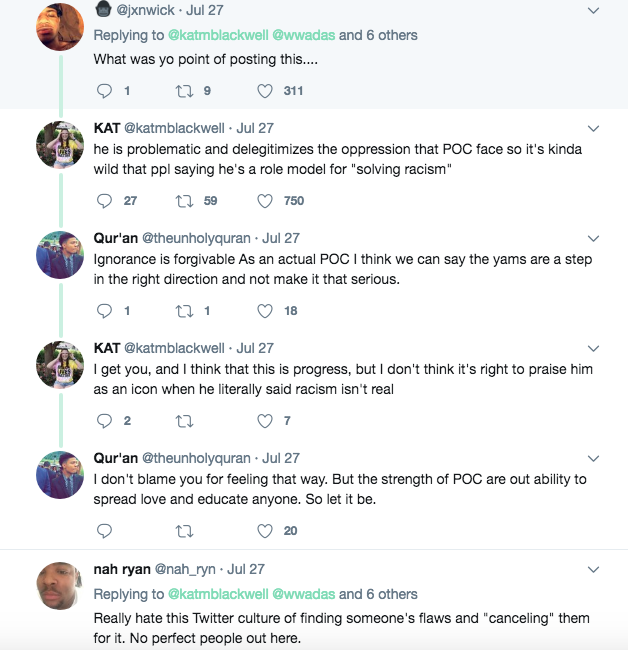
I saw on Twitter last month this tweet regarding candied yams (my first encounter with them):


And then subsequent chain involving a white guy ("@wwadas") who replied that he didn't recognize the candied yams. Black Twitter led him through the process of making the yams, with many praising what seemed to be an increasingly rare instance of building a cultural bridge:
Until others culled through the white guy's tweets to find good ol' boy and obliquely (if not overtly) racist content. Although some immediately tried to shame him, labeling him (not his behavior or beliefs) as being "problematic", other people were less inclined to jump to such conclusions:


It's an interesting thread, with some arguing that every instance of real or perceived injustice must be fought to avoid perpetuating such injustice and another person commenting: "Sorry not everyone is perfect, maybe he's on the way to making things right."

Of course, I may be speaking from a place of bias being religious myself, but I think religion gets it very right in this instance. From one of my favorite LDS talks from Elder Dale G. Renlund:

Just as God rejoices when we persevere, He is disappointed if we do not recognize that others are trying too. Our dear friend Thoba shared how she learned this lesson from her mother, Julia. Julia and Thoba were among the early black converts in South Africa. After the apartheid regime ended, black and white members of the Church were permitted to attend church together. For many, the equality of interaction between the races was new and challenging. One time, as Julia and Thoba attended church, they felt they were treated less than kindly by some white members. As they left, Thoba complained bitterly to her mother. Julia listened calmly until Thoba had vented her frustration. Then Julia said, “Oh, Thoba, the Church is like a big hospital, and we are all sick in our own way. We come to church to be helped.”

Julia’s comment reflects a valuable insight. We must not only be tolerant while others work on their individual illnesses; we must also be kind, patient, supportive, and understanding. As God encourages us to keep on trying, He expects us to also allow others the space to do the same, at their own pace. 

I understand that this requires forbearance from exactly those who are most likely to have been wronged, not just in this moment but from a long history of oppression. I understand this burden to be so heavy that I would not even ask it of anyone, much less demand. I would only hope to help them see, to persuade them that there is greater peace and joy there than in seeking to return the same. Or as Paul Gaugin said: "One day, you will feel a joy in having resisted the temptation to hate, and there is truly intoxicating poetry in the goodness of him who has suffered."

Friday, August 9, 2013

Dealing with mental illness

I really enjoyed this interview between schizophrenic and author Eleanor Longden and author of The Psychopath Test: A Journey Through the Madness Industry Jon Ronson, which is worth reading in its entirety. She talks about how the first voice in her head was just narrating what she happened to be doing, and in some ways she found it calming:

[W]hat research suggests is that voice-hearing (and other unusual experiences, including so-called delusional beliefs) are surprisingly common in the general population. This recognition has led to the popularity of 'continuum models' of mental health, which suggests different traits and experiences are all part of human variation – not strictly categorical in terms of "us and them", "sane and insane", "normal and abnormal". However, I do think life events play a vital role in determining who becomes distressed and overwhelmed and who doesn't. This might include experiences of abuse, trauma, inequality, powerlessness and so on, but it can also include the immediate reactions of the people around you. If you don't have people who will accommodate your experiences, support you, and help you make sense of what's happening, then you're probably much more likely to struggle.

And she wasn't supported or accommodated, instead her friend flipped out, followed by her psychiatrist, until she was institutionalized and the voices got much worse.

[My psychiatrist] really made me feel like a walking inventory of symptoms. This forensic-like scrutiny grew to feel very frightening and de-stabilizing, and was basically sending the message that the only relevant thing about me was my deficits. Not my strengths, not my abilities or resources, just my Bad Brain. I was eventually admitted to hospital (voluntarily), and the impact of that was disastrous because it sealed my perception of myself from someone who was confused, unhappy and frightened into someone with an uncontrollable, carnivorous mental illness. Eventually, I was diagnosed with schizophrenia. The voices (which by this time had multiplied and become much more aggressive) were witheringly contemptuous about this: "You can't even SPELL schizophrenia," one of them said, "So what the hell are you going to do about having it?!"

How did she find her way back?

I don't think there was a single, defining turning point, more an accumulation and fusion of positive changes. Primarily, I was very fortunate to have people who never gave up on me – relationships that really honoured my resilience, my worth and humanity, and my capacity to heal. I used to say that these people saved me, but what I now know is that they did something even more important: they empowered me to save myself. My mum, for example, had an unconditional belief that I was going to come back to her and was willing to wait for me for as long as it took. I also met an amazing psychiatrist, who absolutely didn't subscribe to the idea of me as 'schizophrenic' – or any other label for that matter. "Don't tell me what other people have told you about yourself," he would say, "Tell me about you." 

This led her to a period of profound self-acceptance:

For the first time, I had an opportunity to try and see my voices as meaningful – messages and metaphors about emotional problems in my life – and in turn begin to relate to them more peacefully and productively. I began to understand the voices (as well as my other experiences, like self-injury, anxiety, and paranoid beliefs) in a more compassionate way. Not as symptoms, rather as adaptations and survival strategies: sane reactions to insane circumstances. The voices took the place of overwhelming pain and gave words to it – memories of sexual trauma and abuse, rage, shame, loss, guilt and low self-worth. Probably the most important insight was when I realised that the most menacing, aggressive voices actually represented the parts of me that had been hurt the most – and as such, it was these voices that needed to be shown the greatest compassion and care. Which of course ultimately represented learning to show compassion, love, and acceptance towards myself.
***
But primarily it was when I stopped attacking and arguing with them, and began to try and understand them, and relate to them more peacefully. It was about putting an end to the internal civil war I mentioned earlier, because each of them was part of a whole – me! I would thank them for drawing my attention to conflicts I needed to deal with. I remember one very powerful moment, several years down the line, when I said something like, "You represent awful things that have happened to me, and have carried all the memories and emotion because I couldn't bear to acknowledge them myself. All I've done in return is criticize and attack you. It must have been really hard to be so vilified and misunderstood." There was an immensely long pause before one of them finally responded: "Yes. Thank you."

I found myself relating a lot to this last part -- part of learning to deal with any mental issues is a self-acceptance of yourself, your strengths, and your weaknesses. We all have what Carl Jung called the Shadow, parts of our personality that we would rather not acknowledge about ourselves. But in order for us to become whole, self-actualized human beings, we must not only acknowledge these aspects, but embrace them (see The Tools: 5 Tools to Help You Find Courage, Creativity, and Willpower--and Inspire You to Live Life in Forward Motion for some help on how).

Like most people, I used to ignore my shadow +90% of the time and the other part of the time I became the monster I was afraid I truly was. When I finally cared enough to get better, I knew I couldn't keep doing this, flipping back and forth between the projected-ideal-me and the indulging-every-bad-impulse me. The truth was that both those versions of myself were a distortion, and until I could acknowledge and accept the real me, any changes that I made would be superficial and not-lasting. I saw this same transition in the last season of Dexter, where he finally acknowledges that the "dark passenger" he always blamed for his killing impulse was really just a part of him that he had long ago alienated, and later personified as an external entity. People want me to feel shame for who I am, I can tell. But I'm not going to, because it would make me a much worse person (see also Ted Bundy).

Nobody chooses to be who they are. We make choices and we can define ourselves by our choices if we choose, but there will always be people defining us by other things, including things that we didn't ask for and cannot help. We can't do anything about that either. We just do the best we can and that has to be good enough. As Longden said:

I last heard voices yesterday. They were repeating something I'd read on the internet. The comment was: "I'm going to spoil the ending for you. The ending is – everything's going to be great!"

Thursday, November 1, 2012

Monks, psychopaths, and shameless empaths

All walk into a bar...

This Forbes article, "What Vulnerability Looks Like to Psychopaths, Monks and the Rest of Us," makes an interesting comparison between sociopaths and Buddhist monks (apparently made in Kevin Dutton's book The Wisdom of Sociopaths), before veering off into stream of consciousness nonsense:


Ironically, both psychopaths and Tibetan monks detect deep emotions that are invisible to others.  Psychopaths are much better at recognizing “those telltale signs in the gait of traumatized assault victims” notes The Wisdom of Psychopaths author, Kevin Dutton.

Tibetan monks, steeped in meditative practice, are also especially adept at reading feelings that are hidden from the rest of us, Paul Ekman discovered. Ekman, is the preeminent expert on lying and on the six universally expressed emotions in the face — anger, sadness, happiness, fear, disgust and surprise. Scarily, psychopaths score especially high on the Hare Self-Report Scale of psychopathy in seeing those core expressions, especially the ones that make us most vulnerable, fear and sadness, according to Sabrina Demetrioff.

Not to get overly aspie anal about semantics, but I don't know how it is ironic that both psychopaths and Tibetan monks detect deep emotions invisible to others? I have made the connection before to a psychopath's detachment and a buddhist's detachment.


Unlike our common impression of psychopaths as dangerous serial killers, and some are, others use their high-performing capacity to remain calm in stressful times to conduct surgery, lead soldiers or become sought-after CEOs.  After all, as Dutton suggests, if you’re having brain surgery, wouldn’t you want someone who is not distracted by feelings and completely in control and concentrating on the operation? If your life were in danger on the battlefield, wouldn’t you want someone who could coolly survey the situation and deeply recognize others’ reactions, to determine the best way to rescue you?

Psychopaths adept detection of vulnerability is one of their most potent skills.


At which point the article contrasts Brene Brown's work on shame, and how one need only embrace their vulnerability and let go in order to be more courageous and connect better with others. Of course sociopaths are also shameless, but in a bad way that is different than when empaths acquire a lack of shame? It's not clear, but the article seems to suggest that lack of shame can lead to two very different result: extremely prosocial behavior and extremely antisocial behavior. I agree with that, particularly to the extent that feelings of shame seem to mitigate any extremes in behavior. But I disagree about the implicit distinction that it is psychopaths who would be doing all of the antisocial behavior and that shameless empaths are harmlessly prosocial. It's just odd to see an article come so close to drawing exact parallels between psychopaths and monks, and psychopaths and the empowered shameless empath, and then just sort of assume that monks, empaths, and psychopaths are not the same at all, for some undisclosed reason.

Tuesday, July 3, 2012

Oliver North

I have always thought that Oliver North was an interesting character in history, so I was pleased to see him featured in the book "Power" as a positive example:

In November 1986, U.S. Marine Corps Lt. Colonel Oliver North was fired by President Ronald Reagan from his position at the National Security Council for his involvement in the Iran-contra scandal. Iran-contra involved selling weapons, via intermediaries, to Iran and using the funds from these sales to finance the Nicaraguan resistance then trying to overthrow a left-leaning government. After testifying before Congress in the summer of 1987, North was indicted the following year on 16 felony counts, including accepting illegal gratuities, aiding and abetting the obstruction of a congressional inquiry, and destroying documents and evidence. Although he was convicted on three counts, his conviction was overturned on appeal on the basis that jurors had been influenced by the congressional hearings, during which he had been granted immunity for his testimony. During the nationally televised hearings, North admitted that he had shredded documents, lied to Congress, and violated, or at least come exceedingly close to violating, a law prohibiting giving aid to the Nicaraguan resistance.

But Oliver North knew how to act and speak with power. These abilities would produce an amazing effect on his reputation and his subsequent career. North defended himself and his actions by appealing to a higher purpose—protecting American interests, saving American lives, protecting important U.S. intelligence secrets, following the orders of his superiors, and doing what he was told to do as a good Marine lieutenant colonel—in short, being a good soldier. North wore his ribbon-decorated uniform to the hearings, even though he was seldom if ever in uniform at his job at the NSC. He took responsibility for what he did, saying that he was “not embarrassed” about his actions or about appearing to explain them. And he asserted that he had controlled what had occurred, frequently using phrases such as “I told” and “I caused.” This phrasing demonstrated that he was not running away from what he had done. Observers watching people who don’t deny or run away from their actions naturally presume that the perpetrators don’t feel guilty or ashamed, so maybe no one should be too upset. This phrasing also communicated power, that North was in charge rather than a “victim” of circumstance.

Only seven years after this incident, using the celebrity and sympathy that his testimony created, Oliver North ran for the U.S. Senate from Virginia and lost by just 3 percent of the vote to the incumbent, Charles Robb. During that campaign, North raised some $16 million through direct-mail solicitations, making him the top recipient of direct-mail political funds in the United States that year. Today, North, author of several books, is a television commentator on Fox News and a well-paid speaker at both public and private organizations. And even at the time of the hearings, he enjoyed a positive image. The Wall Street Journal asked dozens of senior U.S. executives if they would hire Oliver North. “The majority said they would…. A poll of the general public reflected the bullishness on Col. North…56 percent of those surveyed said they would hire Col. North; 35 percent said they wouldn’t hire him and 9 percent weren’t sure.”1

Donald Kennedy, a biology professor and former commissioner of the Food and Drug Administration, served as president of Stanford University. Kennedy got caught up in a scandal over indirect costs in the early 1990s. Because it is impossible to associate all the costs of running any organization, for instance, the water and power, police and fire protection, and infrastructure such as libraries, with specific research projects, research grants have an overhead rate that reflects these costs. That rate is then charged to the government for all contracts. In the case of Stanford and other research universities, the claim was that unallowable charges, for instance, for lobbying, liquor, a yacht used by the sailing club, silverware and furniture for the president’s house, and other items, had been included in the cost pools used for calculating the overhead rate.2 After several years of investigation, litigation, and audits, the government found no basis for its claim. Stanford agreed to pay just $1.2 million to the government for overcharges for over 18,000 research grants covering the fiscal years from 1981 to 1992 that involved hundreds of millions of dollars in total funds.3

After the brouhaha broke, Kennedy, like North, appeared before a congressional investigating committee. Donald Kennedy’s performance could not have been more different from North’s. North appeared at the witness stand with just his attorney. Kennedy came with a team that included the head of government contracts from the accounting firm Arthur Andersen, the controller and assistant controller from the university, and the chairman of the board of trustees, James Gaither. This coterie of colleagues conveyed the image that Kennedy could not answer the questions on his own. Using long, convoluted sentences full of subordinate clauses, answering questions indirectly, admitting that he was “embarrassed,” and looking extremely uncomfortable, Kennedy made a weak impression—he looked guilty. He left his position as Stanford president soon thereafter.

The differences between Oliver North’s and Donald Kennedy’s presentations may have had little to do with personality or individual style. Kennedy was not only a distinguished scientist but a successful and effective teacher; he had testified in front of Congress numerous times before, and many people watching his testimony who knew him say he seemed like a different person. He came to the hearings prepared, as did North. What differed was how they chose to present themselves, how they decided to act, and the impression they made. Kennedy wanted to express contrition; North chose to convey incredulity—how could he be questioned?—and some righteous anger. As we will see later in this chapter, expressing anger is usually much more effective than expressing sadness, guilt, or remorse in being seen as powerful.

We choose how we will act and talk, and those decisions are consequential for acquiring and holding on to power.

I think the sociopath has a natural advantage in acting without shame, because we don't react the same way to other people's sense of moral outrage.  Not that sociopaths have the monopoly on shamelessness, but I do think it is one of our more potent weapons in getting away with things and getting what we want.

Saturday, June 9, 2012

Shame and justification (part 2)

For the sociopath's part, I don't think we're motivated by feelings of shame or embarrassment, although I hesitate to make a completely categorical statement.

This is not to say that sociopaths do not come up with stories to explain their behavior, sometimes seemingly outrageous stories like "I killed him because he looked at me funny."  They can and they do.  But everyone wants to explain their behavior. It helps give them a sense of purpose, of self-knowledge, and more importantly of control. If you don't know why you do things, then how do you know that it is even you who is choosing to do them?

The sociopath killer who says he killed someone because of a funny look is not attempting to justify his behavior so much as explain it to himself.  And it is an explanation.  Maybe the killing was an impulsive act, but it was prompted by something, in this case the look the victim gave him.  Perhaps a sociopath might take it one or two steps further and add "I don't allow people to disrespect me," or some general opinion about the small value of human life, but the sociopath is just reflecting on the "why" of the action, not the "what does the fact that I have performed this action say about me and my own concept of self?"  So unlike narcissists, sociopaths don't need to justify their behavior, but they'll still seek to explain it.

Another question the narcissist had was how sociopaths view the bad things we do to other people.  He gave this example of how narcissists view this sort of situation:

E.g. take lions that eat wildebeests. The narcissist lion has to convince himself that the wildebeest has it coming to it, or that the lion is doing the wildebeest a favor by eating it. I'm wondering if the sociopath lion has to engage in that sort of self-deception, or if it can just eat the wildebeest and not give a shit.

I don't think sociopaths really blame people so much as attribute their failings back to them. Using the lion example, the lion doesn't think the wildebeest is a bad person "so it had it coming."  For the sociopath, life is a survival of the fittest.  It's enough for the lion that the wildebeest is unable to defend itself. Why did the wildebeest die? In the sociopath's mind the answer is not "because the lion killed it," but "because the wildebeest couldn't run away or defend itself adequately." That's what is really happening when it seems like a sociopath is blaming someone else for the sociopath's own actions. It's more an assigning of responsibility on the victim for not being more vigilant than it is a justification of self according to some rigid construct of being a "good person," like narcissists do

Sociopaths do not view the entire world through the lens of self as much as narcissists do (not surprisingly).  Narcissists tend to think that everything that happens in their world is some sort of direct reflection of them (good person, bad person, whatever).  Sociopaths understand that they are just a cog in a machine.  While they don't completely give up on that idea of cause/effect and personal accountability, sociopaths are much more inclined to believe that what they do is perhaps meaningless.  As arms dealer Viktor Bout said, “If I didn’t do it, someone else would.”

Friday, June 8, 2012

Shame and justification (part 1)

A narcissist reader and I have been discussing the role of shame and justification as a motivator for narcissists and sociopaths.  Here's his perspective on shame (next post mine):

I think it all comes down to shame and putting up appearances.

If I don't feel shame, and if I don't feel the need to put up appearances so that I can feel good about myself, I'm left just trying to do the things that I want to do, for my own reasons.

As soon as I realized how driven by shame and putting up appearances I've been, it hit me that if I stopped doing that, I would have a tremendous amount of time on my hands. And I'd have a lot of flexibility, because there just isn't that much stuff I genuinely want.

However, when pursuing my own interests, I'm liable to act selfishly and immorally. That's just what comes naturally.

One thing: I'm not a good liar. When I've lied well in the past, it required deceiving myself. The less I delude myself, the harder it is to lie.

I think the key is to become comfortable with shame and with perceiving of myself as a "bad" person.  To the extent I can do that, I seem to just act selfishly and without conscience.


Wednesday, May 2, 2012

No shame (part 2)

A reader sent me this clip from the television show Community to go along with yesterday's post.  One of the characters is trying to get over an ex-boyfriend who is a carnival worker but has an inexplicable draw. The Joel McHale character asks him what the source of his irresistible magnetism is, which he explains in this scene.


Tuesday, May 1, 2012

No shame

I was in a public toilet the other day engaged in some compromising activity when a stranger opened the door, which had not been latched properly. Witnessing the stranger's horror at barging in on me was very pleasurable to me. I thought in that moment that most people would be extremely embarrassed by this episode, but I am only enjoying the discomfort that I have induced in my unwilling voyeur. Sigh.

Saturday, April 21, 2012

Narcissists vs. Sociopaths (part 3)

(cont.)


I'm Low Empathy. Am I a Sociopath or a Narcissist?

If you know you are low empathy, and you just don't care about others finding out, you are a sociopath.
If you do bad things, but think your empathy is just fine, but you've got a nagging fear that maybe there is something wrong with your empathy, but you definitely don't want others to find out - you are a narcissist.

If you don't feel any shame when you get caught, you are a sociopath.
If you feel shame when getting caught, you are a narcissist.

If you do bad things because you are on a crusade, you are a narcissist, or a malignant narcissist. Decide between the two alternatives based on how cruel and impulsive you are.

If do bad things because it is good for you, and don't mind if others know it (except when it gets in the way of you winning) you are a sociopath.

Friday, April 20, 2012

Narcissists vs. Sociopaths (part 2)

(cont.):


A few points:

Narcissists are addicted to admiration.  Despite looking down on everyone else, they crave admiration from others. They fish for compliments. They strive to accomplish things to win the admiration of others.

Sociopaths don't need admiration from others. They crave power.

Shame is the uncomfortable perception that one's "self" is bad, and doesn't live up to a societal standard. E.g. you steal something because you want it. You don't feel guilt because you don't think your stealing was bad (you have a different sort of conscience than normal people). Then you get caught. If you feel uncomfortably exposed, that feeling is called shame. Sociopaths don't feel shame. Narcissists feel shame very often, but may be completely ignorant that they are feeling shame.

Narcissists are generally unaware of their thoughts, feelings, how others perceive them, etc. To stay comfortable, they deceive themselves about their shortcomings, by ignoring their own constant thoughts of inadequacy, and ignoring any resulting feelings of shame.

Sociopaths know that they don't have strong emotions. They know they fake emotions to fit in. They don't care about the feelings of others, so they don't feel shame.

Narcissists make great cult leaders. Many founders of businesses (e.g. Steve Jobs, Bernie Madoff) are narcissts or malignant. They will generally explain that they are on a quest to change the world for the better.

Thursday, May 6, 2010

Shaming

I have become increasingly disenchanted with humanity, particularly these last few months. I think it may have something to do with being sick for a long time and never really catching up. It also may have something to do with the amount of traveling I have had to do, particularly international flights with immigration and customs checks.

The other day I had just boarded a plane and was trying to get an email sent before we took off. It was such a small plane that there was only a minute between when we were asked to shut off any electronics* and enforcement. After the announcement, I finished the sentence I was on and pressed send, but the connection was bad and I couldn't tell whether it had sent or not. I attempted to resend. At this point, I could have hidden the phone while the phone searched for a connection, but i decided to be honest about it and do it within plain sight. Halfway through attempting to resend, the flight attendant reprimanded me for not having turned the phone off already, trying to shame me in front of the other passengers. I quickly got very angry. My friend says "it's when you are trying to be legit and people still chastise you that you get the most irate." True. He also said that the flight attendant would probably not have been so angry if I had actually attempted to hide the phone, instead of blatantly and openly defying the order. Maybe also true. But I controlled my anger well, only giving the flight attendant chilling death glares. I think I must have creeped her out sufficiently, though, because I looked up a few times in the flight and saw her staring at me with a look of bewilderment and fear.

This incident was not a big deal, but it did remind me that I don't respond well at all to shaming attempts. I don't know why people would ever use them (particularly with people like me around) or over something so small as mobile phone etiquette. I always think -- poor phone etiquette is the least of your worries with me, guy. I think if people had to choose only one thing to worry about, there are many other things that should be prioritized, including the wisdom of sleeping with one eye open.

I'm sure there was originally some evolutionary impetus for shame and shaming, but can it really still be applicable? Effective? Safe?


*is there a legitimate reason for this rule?
Join Amazon Prime - Watch Over 40,000 Movies

.

Comments are unmoderated. Blog owner is not responsible for third party content. By leaving comments on the blog, commenters give license to the blog owner to reprint attributed comments in any form.