Showing posts with label datamine. Show all posts

Wednesday, May 28, 2014

Sociopath quote: Calculating machine

"Bear in mind that my brain works like a calculating machine. Each person who makes a presesntation to me introduces into this calculating machine a small wheel of information. There forms a certain picture, or a number on each wheel. I press a button and there flashes into my mind the sum of all this information."

--Adolf Hitler

Friday, May 2, 2014

Manipulation 106: Listening

We talk a little about datamining here and I think some people think it sounds nefarious, like we are going through people's trash or stealing their mail or something.  Not always! Most of the time we are just using the secret tactic of "good listening skills". See also, this NY Times article "At Airports, a Misplaced Faith in Body Language." After going on about for quite a bit about how useless the billion dollar United States' TSA (airport security) body language training program is (an attempt to get TSA workers to identify criminals and terrorists by how they comport themselves physically), I loved this gem:

In experiments at the University of Chicago, Dr. Epley and his colleagues have found that people vastly overestimate how much mind reading they can do by looking at someone’s facial expressions.

“Reading people’s expressions can give you a little information, but you get so much more just by talking to them,” he says. “The mind comes through the mouth.”

Mastermind! The words people say often says more about them than what their body language says about them. That's where most of the datamining is coming from -- what you volunteer. This is especially true with social media. I think people just don't realize this because most of the time they don't care what people are saying, so they assume that no one cares what they are saying either. If you've ever been charmed by someone you have a crush on remembering your birthday, you'll understand how effective it is to listen and remember what people say. Or creepy:

Thursday, April 10, 2014

Obsessive Compulsive Disorder

The older I get, the more my obsession with efficiency and decisionmaking provokes me to behave in quirky ways, giving me every appearance of suffering from obsessive compulsive disorder (emphasis on compulsion).

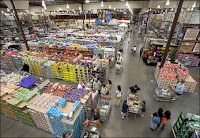
Every month or two I make a small trek to a warehouse store. At the store I buy the same approximately 20 items in various quantities (small amounts of hummus, large amounts of palm hearts). I eat these items in a particular order, prioritizing the fresh fruits and vegetables in order of their spoilage, shifting then to baked goods that have a slightly longer shelf life, and finally to canned and frozen foods until I am able to make another trip to start the cycle over again.

My approach to shopping at the warehouse store is a ritualistic self-indulgence of the extremes of my desire to control. Because I am never sure what fresh fruits and vegetables will be available, I start there (what I am able to acquire in fresh fruits may alter slightly my choices in the frozen foods section, and finally in the dry and canned goods section). Even though I have a list and even though I buy nearly identical items at each trip, I still spend approximately 2-3 minutes with each item, even more for produce. I look at the quality, looking for flaws, looking at spoilage dates, comparing the item I selected with other identical items to determine slight variations. I do this carefully and methodically, trying to remain focused as my body suffers through the artificial chill of the produce section’s walk-in refrigerator. I then do the same for each other type of food, frozen foods, dry and canned goods, as well as any paper goods. I walk fastidiously through each aisle, paranoid that I will neglect some forgotten need and have to go without for another month or two.

As I stand in line to pay for my purchases, I sometimes smile at the odd picture the bizarre array of foods makes, each one of them a carefully chosen trade-off between convenience and nutrition, taste and perishability, versatility and diversity. Are people more likely to believe that I am throwing a theme party (assorted beverages and ethnic foods) or that I have Asperger’s (16 jars of palm hearts)?

But after years of this self-indulgence I can’t go to a normal grocer’s anymore; at least I can’t go and feel satisfied about the experience. My datamining mind chokes on the sheer amount of data involved for choosing each item: the unknowns (taste, quality, perishability, nutrition, price, etc.) multiplied by the number of options. People say “a whole aisle of bread,” like it is a good thing, but to me it is horror.

The last time I went to a grocery store was a whim—I needed to kill time waiting for an appointment so I thought I would buy rye bread because I love it and my warehouse store does not stock it. When I walked into the bread aisle, I was aghast. There were 8 different types of rye bread. I looked at each one, comparing the descriptions of taste, comparing the color and feel, comparing the nutritional information and the ingredients list. After 20 minutes and about to become paralyzed with indecision, I picked one loaf of each—all 8 different types of rye bread. (I am still eating rye bread from that trip, the loaves suffering serious freezer burn.)

And that is why I like to shop at the warehouse store. There are not 100 different types of bread, there are 5. There are not 20 different types of yogurt, there are three. There are only two types of bacon, regular and turkey, and only one type of egg whites in tetrapak. Going to the warehouse store is a satisfying experience in which I am quite certain that I can make the best possible choices given my options. Given my love/hate relationship with food and my particular dietary needs, I avoid going to a large grocery store for the same reasons I avoid going to a used car lot .

UPDATE: Interestingly, James Fallon said that he was at one point diagnosed with both an anxiety disorder and OCD

Thursday, December 5, 2013

Substituting you for me

A pilot friend of mine was describing to a dilettante friend of ours the process of obtaining a pilot's license. He talked about what it means to "fly blind," or fly relying solely on the instruments, not being able to see anything out the windows of the cockpit, or at least not looking. Obviously you wouldn't want to fly blindly if you had the option to also see outside, but the point is that sometimes you don't have that option, or sometimes what you are seeing with your naked eye can be deceptive.

While he was describing the sort of psychological self-mastery it takes to ignore everything that you think you know about your situation and instead put all of your trust in fallible tinker toys of gauges (which you may not even understand how they operate), I couldn't help but think of the way I struggle to ignore meaningless but strong impulses or emotional hallucinations.

I have talked before about relying on a prosthetic moral compass to compensate for my lack of conscience. I have also talked about my understanding of the utility of trust. By that I mean, substituting someone else's judgment for my own -- particularly principled people I know who have managed to achieve a stable sort of success and happiness.

A small example of an exercise of trust involves a relative of mine. He is a lover of technology, a proud first adopter. I have never really been a gearhead of any sort, so I always have him choose my set-ups. He is not my advisor for buying/adopting tech type stuff, he actually makes decisions for me. I was talking with a work colleague the other day about it. I told him I admired his laptop, to which he replied I should just buy my own. I explained to him that my technologically more sophisticated relative hadn't told me I should/could, and that he makes all my tech decisions for me. When my colleague suggested that I just do it anyway, I realized he misunderstood the nature of me "trusting" someone else to make decisions for me. If I just bought whatever I wanted when I wanted, then he would no longer be making decisions for me, he would be making suggestions to which I could either follow or not follow, or at best he would be making demands that I could veto. That would defeat the whole point of me putting him in charge of that aspect of my life.

To the extent I believe that there is value in things like "faith" or "trust," it is that you ignore your own ideas about what you think you know and rely on something, not because it is infallible, but because it is a different sort of fallible than you. That's why I don't understand people who say they have faith in something, a religion perhaps, but only when it's convenient or it happens to coincide with how they would have chosen anyway. Maybe this is a downside to my personality, the ability and willingness to just follow blindly. I don't think it is always a good thing, and it certainly has its downsides (as does deciding yourself). But to the extent it is useful at all, I believe it is only in this way.

Friday, November 8, 2013

Datamining

People sometimes ask me what does it mean when sociopaths say they datamine. Basically they are collecting information about you in an effort to predict your future behavior and what might please or displease you. In this way, they are not much different than Google, Facebook, Orkut, or the other programs that kids are into these days. This was a good description of how these programs work, from Mind Hacks:

The Economist has an excellent article that discusses the increasingly diverse ways in which information from your social network – drawn from services like Facebook, or from telephone calls or payment patterns – are being used to obtain personal information about you.

This is not information which you have explicitly stated or included, but which can be found out or ‘mined’ from your patterns of behaviour and your connections to other people.

And from the Economist article mentioned, the fascinating way in which phone companies target trend-setting customers:

Telecoms operators naturally prize mobile-phone subscribers who spend a lot, but some thriftier customers, it turns out, are actually more valuable. Known as “influencers”, these subscribers frequently persuade their friends, family and colleagues to follow them when they switch to a rival operator. The trick, then, is to identify such trendsetting subscribers and keep them on board with special discounts and promotions. People at the top of the office or social pecking order often receive quick callbacks, do not worry about calling other people late at night and tend to get more calls at times when social events are most often organised, such as Friday afternoons. Influential customers also reveal their clout by making long calls, while the calls they receive are generally short.
Similarly, sociopaths watch your behavior to figure out who you are. It can be something as small as the way you grip a steering wheel when you drive or whether you break prolonged eye contact and when. The sociopath collects all of this information about you and mentally references it to the thousands of other people he has collected information from, coming up with a rough sketch of who you are. As marketers have known for centuries, people that like certain things will probably like other similar things.

It's not hard to collect this information, the sociopath is paying attention to these little behavioral responses anyway to make sure that he is remaining undetected. And it's hard not to notice certain very common human behavioral patterns, once you've been made aware of them.

After the sociopath has collected all of this information, he can use it in various ways. He can use it to better construct his own masks to stay hidden. He can use it to anticipate your every need and desire. Or he can use it to get into your mind and plant yet another type of mine. That's the mining that you really should be worried about, and the only way that the sociopath can set traps in your mind is if you have weaknesses or needs that you refuse to address yourself.

Apart from that, datamining of any type is relatively harmless. It's basically just catering to your expectations.


Thursday, November 29, 2012

Manipulation 102: retail sales

I was reading this NY Times article on the clothing brand Zara and was impressed by how they managed to create and sustain demand for their products. First of all, they are faceless, their founder never having given an interview and their designers nameless:

Ortega has never given an interview, according to his communications department, nor does he attend award ceremonies or parties. He rarely allows his picture to be taken. Pablo Isla, who took over the company when the 76-year-old Ortega stepped down as chairman last year, rarely gives interviews or waves to the camera, either. In fact, the public face of Inditex is its soft-spoken communications director, Jesus Echevarría, who, as I discovered during a recent visit to the Inditex complex, is perhaps the only communications director on the planet who all but apologizes whenever he must answer questions about Inditex’s runaway success.
***
Inditex owes none of its success to advertising. That’s because Inditex doesn’t advertise. It hardly even has a marketing department, and it doesn’t engage in flashy campaigns, as its competitors do, teaming up with fashion designers like Stella McCartney, Karl Lagerfeld, Martin Margiela and Marni. Zara’s designers are completely anonymous; some would say this is because they are copiers rather than designers.

I actually think this is one of the bigger benefits of having an anonymous blog -- being nameless and faceless just makes it easier for people to project what they want to see onto you.

Zara doesn't self-promote, instead they let their satisfied customers talk them up:

“In New York, they did one page saying they were opening — in The New York Times,” Echevarría said. “But it’s not a campaign; it’s an announcement; it’s information. The company does not talk about itself. The idea was that the client was to talk about the company. It was not to say how good it could be. The customer would say that if it was deserved.”

This is one of my favorite ways to seduce, partly because I'm actually very lazy about it. I would much rather just become known as somewhat of a desired commodity and have people come to me rather than the other way around. Although I do sometimes go out with the goal of meeting people and can be very aggressive when I want to be, I find that I get better longterm results this way. People think it's their choice and that gives them a false sense of control and they have an incentive to keep justifying the choice to themselves (who wants to admit they were wrong?) by continuing to idealize me.

Zara is not a one-model fits all operation, it (sneakily) tries to closely follow the idiosyncrasies of its clientele:

But a brand at Inditex will make a fall collection, for example, and then ship only three or four dresses or shirts or jackets in each style to a store. There’s very little leftover stock, few extra-smalls or mediums hiding in the back. But store managers can request more if there’s demand. They also monitor customers’ reactions, on the basis of what they buy and don’t buy, and what they say to a sales clerk: “I like this scooped collar” or “I hate zippers at the ankles.” Inditex says its sales staff is trained to draw out these sorts of comments from their customers. Every day, store managers report this information to headquarters, where it is then transmitted to a vast team of in-house designers, who quickly develop new designs and send them to factories to be turned into clothes.
***
That means that if Inditex stores in London, Tokyo and São Paulo all have customers responding enthusiastically to, let’s say, sequined cranberry-colored hot pants, Inditex can deliver more of these, or a variation on hot pants, sequins or that cranberry color, to stores within three weeks. The company tries to keep the stock fresh; one promise its stores make is that you will always be buying something nearly unique. Merchandise moves incredibly quickly, even by fast-fashion standards. All those thousands of Inditex stores receive deliveries of new clothes twice a week.

This reminded me of the way I will constantly datamine little tidbits of information on people to add to my  mental dossiers of them that help me cater to their unique desires.

Finally, they promote a feeling of scarcity, causing people to want to buy when they feel the urge because the opportunity may never present itself again:

In this way, says Masoud Golsorkhi, the editor of Tank, a London magazine about culture and fashion, Inditex has completely changed consumer behavior. “When you went to Gucci or Chanel in October, you knew the chances were good that clothes would still be there in February,” he says. “With Zara, you know that if you don’t buy it, right then and there, within 11 days the entire stock will change. You buy it now or never. And because the prices are so low, you buy it now.”

This one is probably the hardest for me to pull off if I am honestly interested in the person, but I have seen it be very effective when I truly am only feeling a fleeting interest in a person. Ah well, there is always room for improvement.
Join Amazon Prime - Watch Over 40,000 Movies

.

Comments are unmoderated. Blog owner is not responsible for third party content. By leaving comments on the blog, commenters give license to the blog owner to reprint attributed comments in any form.