Showing posts with label uniquely gifted. Show all posts

Sunday, February 21, 2016

Average and unique

I thought this was an interesting NPR interview regarding what it really means to be average (is anyone really?) or unique (is anyone not?). Most of it is with regards to education, but the points made about statistics would seem to apply to general categorizations we make of people (e.g. introvert/extrovert), but also -- to the extent that all psychological criterion take into account the culture of those they are being applied to (pedophilia is not going to mean the same in a culture in which the average marriage age is 13, sadness doesn't necessarily mean your depressed if you are just expressing a culturally appropriate amount of grieving, criminality in one culture is entrepreneurship in another, etc.)  -- to the world of psychology.

Rose talked with us about his new book: The End Of Average: How We Succeed in a World That Values Sameness.

The opening example you use in the book is that in the 1940s, when the Air Force designed cockpits based on the average measurements of the pilots, there were an unacceptable number of crashes. But when they went back and measured thousands of pilots, across 10 body dimensions, they found that zero of them even came close to the "average" on all 10. So they concluded that they had to redesign the seats and so forth to be adjustable to each person.

Body size is a very concrete example of what I call jaggedness. There is no average pilot. No medium-sized people. When you think of someone's size you think of large, medium, small. Our mass-produced approach to clothing reinforces that. But if that were true you wouldn't need dressing rooms.

So dimensions like height and weight and arm length and waist circumference ...

Yes, they're not nearly as correlated as you would think. Height is one-dimensional, but size isn't. People are jagged in size, in intelligence, everything we measure shows the same thing.

I'm going to quote a line from the book, said to psychologist Paul Molenaar, who is arguing for a greater focus on individual difference: "What you are proposing is anarchy!" How do you make decisions about people if you can't use statistics and cutoff scores and compare them to averages?

People feel like if you focus on individuality, everyone's a snowflake, and you can't build a science on snowflakes. But the opposite has been true.

It's not that you can't use statistics, it's just that you don't use group statistics. If I want to know something about my daily spending habits, one straightforward way would be to collect records of what I spend every day. To take an average for myself would be perfectly fine.

So you can generalize across time, but not across people?

We've got to let go of putting a group into a study and taking an average and thinking that's going to be close enough to universal insight.

Now we have something better. We have a natural science of individuality that gives us a surer foundation. We've gotten breakthrough insights in a whole range of research, from cancer to child development.

Friday, January 10, 2014

The Dark Side of Emotional IQ?

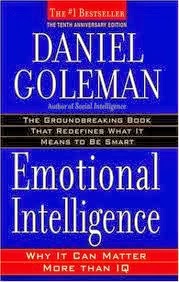
Daniel Goleman popularized the term emotional intelligence in his book "Emotional Intelligence: Why it Can Matter More Than IQ". Apparently people are just now realizing that emotional intelligence is basically a prerequisite for effective manipulation and emotional deceit? Adam Grant writes for The Atlantic about "The Dark Side of Emotional Intelligence":

In some jobs, being in touch with emotions is essential. In others, it seems to be a detriment. And like any skill, being able to read people can be used for good or evil.

Since the 1995 publication of Daniel Goleman’s bestseller, emotional intelligence has been touted by leaders, policymakers, and educators as the solution to a wide range of social problems. If we can teach our children to manage emotions, the argument goes, we’ll have less bullying and more cooperation. If we can cultivate emotional intelligence among leaders and doctors, we’ll have more caring workplaces and more compassionate healthcare. As a result, emotional intelligence is now taught widely in secondary schools, business schools, and medical schools.

Emotional intelligence is important, but the unbridled enthusiasm has obscured a dark side. New evidence shows that when people hone their emotional skills, they become better at manipulating others. When you’re good at controlling your own emotions, you can disguise your true feelings. When you know what others are feeling, you can tug at their heartstrings and motivate them to act against their own best interests.

[…]

Shining a light on this dark side of emotional intelligence is one mission of a research team led by University College London professor Martin Kilduff. According to these experts, emotional intelligence helps people disguise one set of emotions while expressing another for personal gain. Emotionally intelligent people “intentionally shape their emotions to fabricate favorable impressions of themselves,” Professor Kilduff’s team writes. “The strategic disguise of one’s own emotions and the manipulation of others’ emotions for strategic ends are behaviors evident not only on Shakespeare’s stage but also in the offices and corridors where power and influence are traded.”

Dark side? Saying emotional intelligence has a dark side because it makes you better at influencing people to act and choose in ways that they might not otherwise have chosen is sort of like saying intelligence has a dark side because frequently people who make smart choices also happen to foreclose opportunities for other people. Not everything in life is a zero sum game, but often when there are winners there are also losers, e.g. most stock trades. And isn't the ability to persuade and even manipulate people one of the carrots for learning emotional intelligence in the first place? The same way that the ability to earn more and engage in more of life is an incentive to cultivate ones' other intelligences? Are we trying to defang nature?

Tuesday, November 13, 2012

Raising genius

I really enjoyed this article by Andrew Solomon in the NY Times Magazine, "How do you Raise a Prodigy?" I thought the parallels between raising a prodigy and raising a sociopath were compelling. He first talks about his recent research in parents that raise children with special issues:

Prodigies are able to function at an advanced adult level in some domain before age 12. “Prodigy” derives from the Latin “prodigium,” a monster that violates the natural order. These children have differences so evident as to resemble a birth defect, and it was in that context that I came to investigate them. Having spent 10 years researching a book about children whose experiences differ radically from those of their parents and the world around them, I found that stigmatized differences — having Down syndrome, autism or deafness; being a dwarf or being transgender — are often clouds with silver linings. Families grappling with these apparent problems may find profound meaning, even beauty, in them. Prodigiousness, conversely, looks from a distance like silver, but it comes with banks of clouds; genius can be as bewildering and hazardous as a disability.

He then goes on to express some of the particular difficulties in raising any child who is different than the norm, particular a child who is different from the parents themselves, and how there are no easy rules:


Children who are pushed toward success and succeed have a very different trajectory from that of children who are pushed toward success and fail. I once told Lang Lang, a prodigy par excellence and now perhaps the most famous pianist in the world, that by American standards, his father’s brutal methods — which included telling him to commit suicide, refusing any praise, browbeating him into abject submission — would count as child abuse. “If my father had pressured me like this and I had not done well, it would have been child abuse, and I would be traumatized, maybe destroyed,” Lang responded. “He could have been less extreme, and we probably would have made it to the same place; you don’t have to sacrifice everything to be a musician. But we had the same goal. So since all the pressure helped me become a world-famous star musician, which I love being, I would say that, for me, it was in the end a wonderful way to grow up.”

While it is true that some parents push their kids too hard and give them breakdowns, others fail to support a child’s passion for his own gift and deprive him of the only life that he would have enjoyed. You can err in either direction. Given that there is no consensus about how to raise ordinary children, it is not surprising that there is none about how to raise remarkable children. Like parents of children who are severely challenged, parents of exceptionally talented children are custodians of young people beyond their comprehension.

I love the Lang Lang quote. It is such a great acknowledgment that different folks require different strokes. If there is anything that I hope to achieve with the blog and getting people to think about the presence and role of sociopaths in society, it is probably to preach this gospel that we're all really different from each other in ways that we too often either ignore or pretend don't exist. There's nothing wrong with heterogeneity, in fact it is probably what keeps us so viable as the dominant species on this planet. Monster babies are born into all types of family every day. But the word monster need not mean B movie horror matinees, it could also be someone more like Lang Lang.

Tuesday, April 10, 2012

Original thinker

I was reading a New Yorker article (here is the abstract) about the Dutch artist/sculptor/engineer responsible for Strandbeests ("beach animals"), Theo Jansen.  He had an interesting quote that made me think about what a benefit it is to the individual and society to be able to think in an original way:

Mine is not a straight path like an engineer's, it's not A to B.  I make a very curly road just by the restrictions of goals and materials.  A real engineer would probably solve the problem differently, maybe make an aluminum robot with motor and electric sensors and all that.  But the solutions of engineers are often much alike.  Everything we think can in principle be thought by someone else.  The real ideas, as evolution shows, come about by chance.  Reality is very creative.  Maybe that is why the Strandbeests appear to be alive, and charm us.  The Strandbeests themselves have let me make them.

I don't know why I thought this was relevant.  I guess because sociopaths minds are so different than most people.  I think their minds, thoughts, and behavior can seem charming because of their uniqueness.  Sociopaths can have the innocence of an ingenue or the ruthless of the most determined predator.  There's something sort of refreshing about their brutal approach to the world.  And when we live in a world where "everything we think can in principle be thought by someone else," it might be nice to be around someone who is an entirely different "someone else" than you are.


Friday, August 21, 2009

Sociopath voices

I always like to present the views of other sociopaths when i can. Here is what one reader calls his declaration of independence:
"We are the uniquely gifted"

"Sociopath" is a misleading word: it implies a disorder, something wrong and unnatural with the person, and this couldn't be further from the truth. We, the people you refer to as sociopaths, have nothing wrong with us. We are instead, the uniquely gifted. Our gifts have been mischaracterized and maligned and it’s time someone set the record straight.

What the experts call superficial charm, I call having a natural ability to win friends and influence people. What experts call manipulative and conning, I call an affinity for persuasion based upon an innate ability to pinpoint others personality strengths and weaknesses. What the experts decry as a lack of compassion, I call pragmatism and clarity. What experts call a “problem with authority”, I call embracing personal power and celebrating the independent spirit. What experts call “delusions of grandeur”, I call self confidence and optimism. What experts call “shallow emotional affect,” I call freedom from the tyranny of irrational emotions. And finally, while the experts say that guiltlessness is a disorder (because it is the lack of guilt that separates the sociopath, psychopath and Machiavellian from the general population), I say it is the enhanced ability to do the things that build civilizations and keep societies going, the very things that the guilt afflicted shy away from. It is no coincidence that our lack of guilt so often comes with abnormally high intelligence and charisma.

We are born to lead and many of our traits support this conclusion. We are born knowing this and the rest of you know it when you see us. It is these very traits that make us necessary for the survival and success of the human species, especially since the dawn of civilization. It’s why you elect us, follow us, and often give your very lives by our command. Though we are found disproportionally in prisons we are found with even greater frequency in your governments, your corporations, your military. Who else but someone devoid of conscience could order thousands of soldiers to die, regardless of how noble the cause? Who can fire hundreds of workers to save a company from bankruptcy and then sleep peacefully that night? Who can so elegantly tell the lies that must be told, to protect the very people to whom the lies are told? It takes one of us to make those calls, the calls that the rest of humanity cannot make.

And yet a distressing number of us become the very thing you fear us all to be; criminals and abusers. This creates a cycle of ignorance, as all the "sociopaths" identified by the news are killers or wife-beaters, and so we identify this collection of gifts as evil, as pathological, and thus those of us in our proper roles feel the need to disguise ourselves for fear of being labeled evil. A similar cycle of ignorance has kept homosexuals oppressed for decades; homosexuality has been associated with child molesters and perverts, drug use and disease, and it was called "evil" for this.

We are not evil; you simply do not recognize the “good” ones as the same phenomena. Google "sociopath" and all you find are ways to recover from contact with a sociopath, information advising you to run from relationships with sociopaths, and misinformation that will claim that "sociopaths cannot feel love" or that we "cannot think of others as human beings" or that we are "parasitic".

It is very distressing to discover, for a child who has always known that he was different, that he is a monster... that he is doomed to live a loveless life and become a criminal, that he will never be able to hold a job or raise a family. Indeed, one must wonder how often do one of us accepts the mischaracterization of our abilities and instincts as things to be repressed and rejected due to ignorance? How often do the young among our frequently demonized minority discover what he is, buys into the paranoid misinformation and simply does what he is expected to do, withholding from society the very qualities it needs and secretly wants to maintain itself and imprisoning himself in a state of confusion and needless pain as a result?

What is the so called sociopath? A sociopath is one of your potential leaders, labeled by the fearful and unreasoning masses as something sick and evil. "Sociopath" is a negative label which only serves to further alienate people who simply need to be allowed to embrace their gifts. Getting rid of this misleading term should be the first step towards fully understanding who we are and the role we play in this world. We are not the embodiment of a pathology. On the contrary; we are instead the uniquely gifted.
Join Amazon Prime - Watch Over 40,000 Movies

.

Comments are unmoderated. Blog owner is not responsible for third party content. By leaving comments on the blog, commenters give license to the blog owner to reprint attributed comments in any form.